Nose Shapes: Types of Noses With Names and Pictures
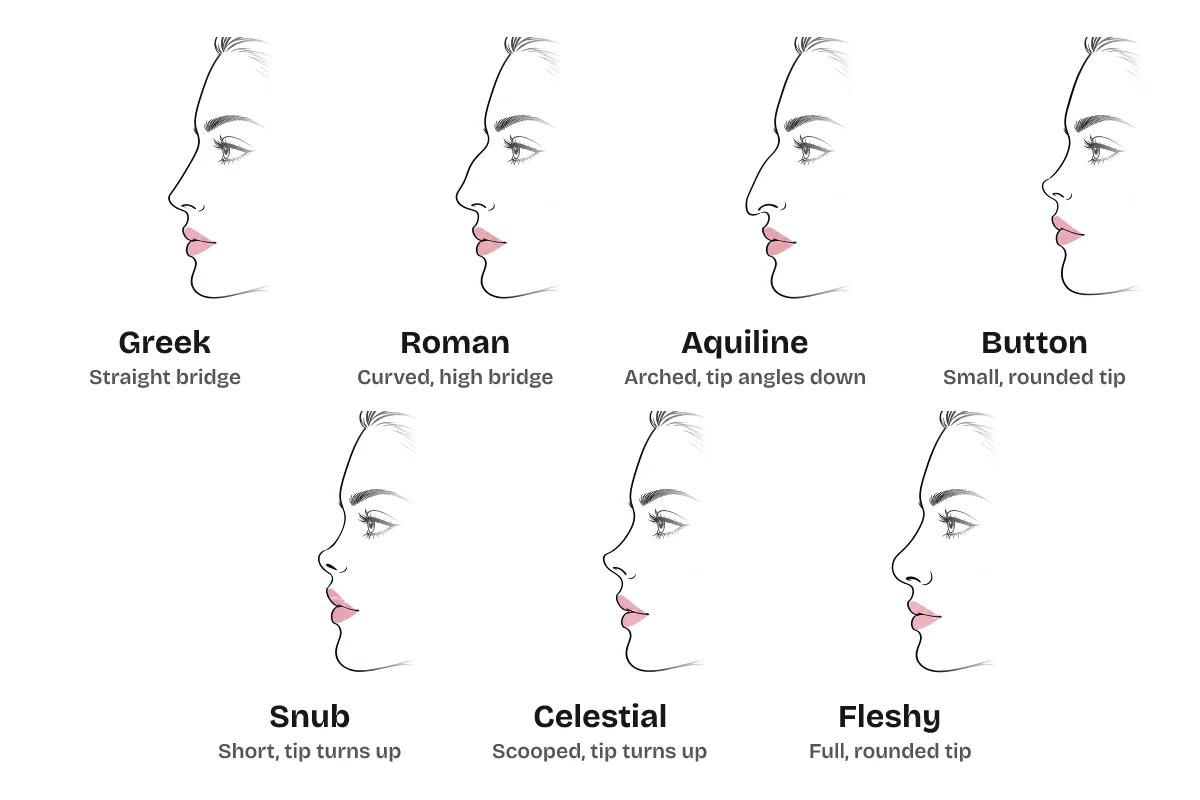
The three features that name a nose
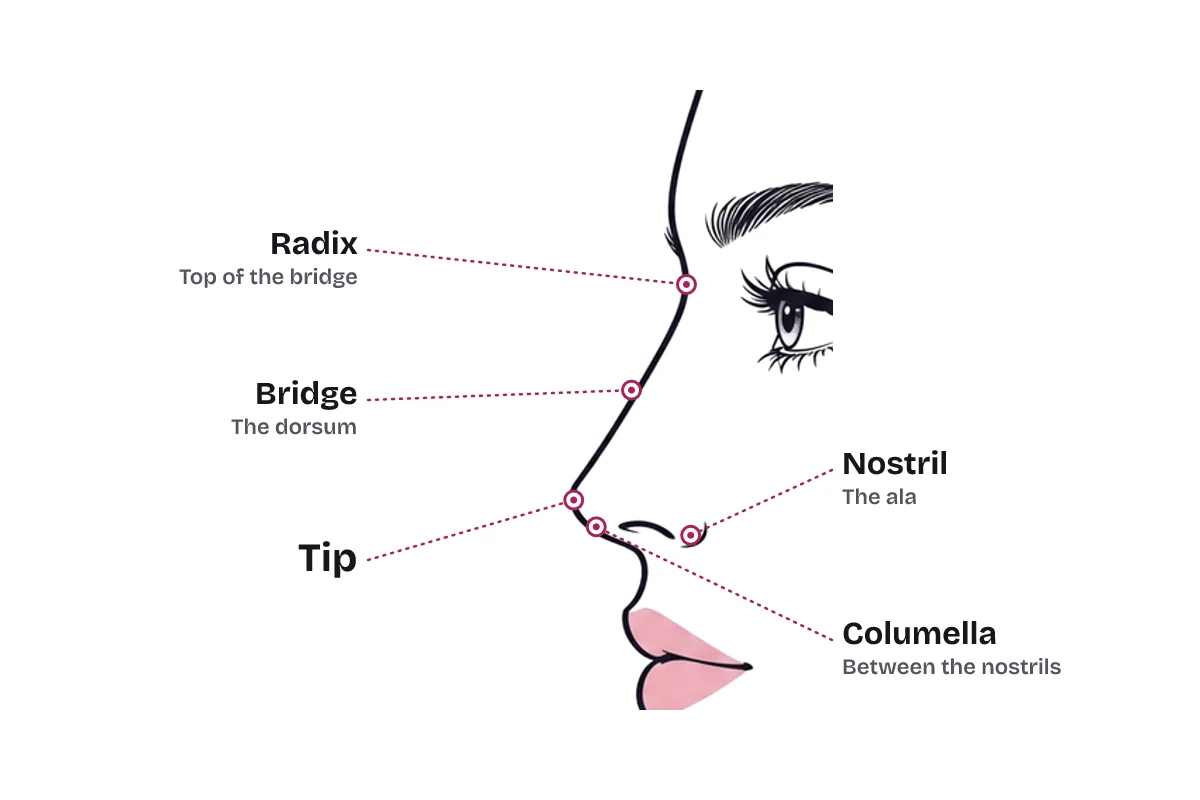
Every nose type is shorthand for a combination of three features. Once you can see them separately, the names stop being confusing.
The bridge. Running from the radix (the dip between your brows) down to the tip, the bridge is also called the dorsum (StatPearls). Seen from the side, it can follow a straight line, rise outward in a curve, or dip slightly inward before the tip. How deep the radix sits changes how the whole bridge reads: surgeons note that the same bridge looks like it has a hump when the radix is deep, and looks straight when the radix is shallow and the nose flows directly from the forehead.
The tip. The tip can point upward, straight ahead or slightly downward. That direction shows up in the angle between the underside of your nose and your upper lip. The tip also has a size, from small and defined to full and rounded.
The width. From the front, the base of the nose spreads across the nostrils (the alae). A handy reference is the gap between your inner eye corners, which is often close to the width of the nose base.
Named types are particular mixes of these: a straight bridge with a forward tip is Greek, a curved bridge with a downward tip is aquiline, and so on.
How to tell your nose type
The nose shape detector measures your nose width and tip from a front photo on your device, then lets you choose your profile from simple drawings.
Open the nose shape detectorYou’ll need a side view, which a mirror alone won’t give you. Ask someone to take a photo of your profile at eye level from about 1.5 m (5 feet), or use the timer on your phone. Then:
- Lay a straight edge along the bridge. On the photo, place a ruler or the edge of a card from the radix to the tip. If it touches all the way along, your bridge is straight. If it rocks on a bump in the middle, your bridge curves outward. If there’s a gap under it, your bridge is scooped.
- Check the tip direction. Look at the angle between the underside of your nose and your upper lip. Clearly more than a right angle means an upturned tip; roughly a right angle means a forward tip; less than a right angle means the tip angles down.
- Judge the tip size. Small and rounded, clearly defined, or full and soft.
- Compare the width from the front. In a straight-on photo taken from arm’s length, compare the width across your nostrils with the gap between your inner eye corners.
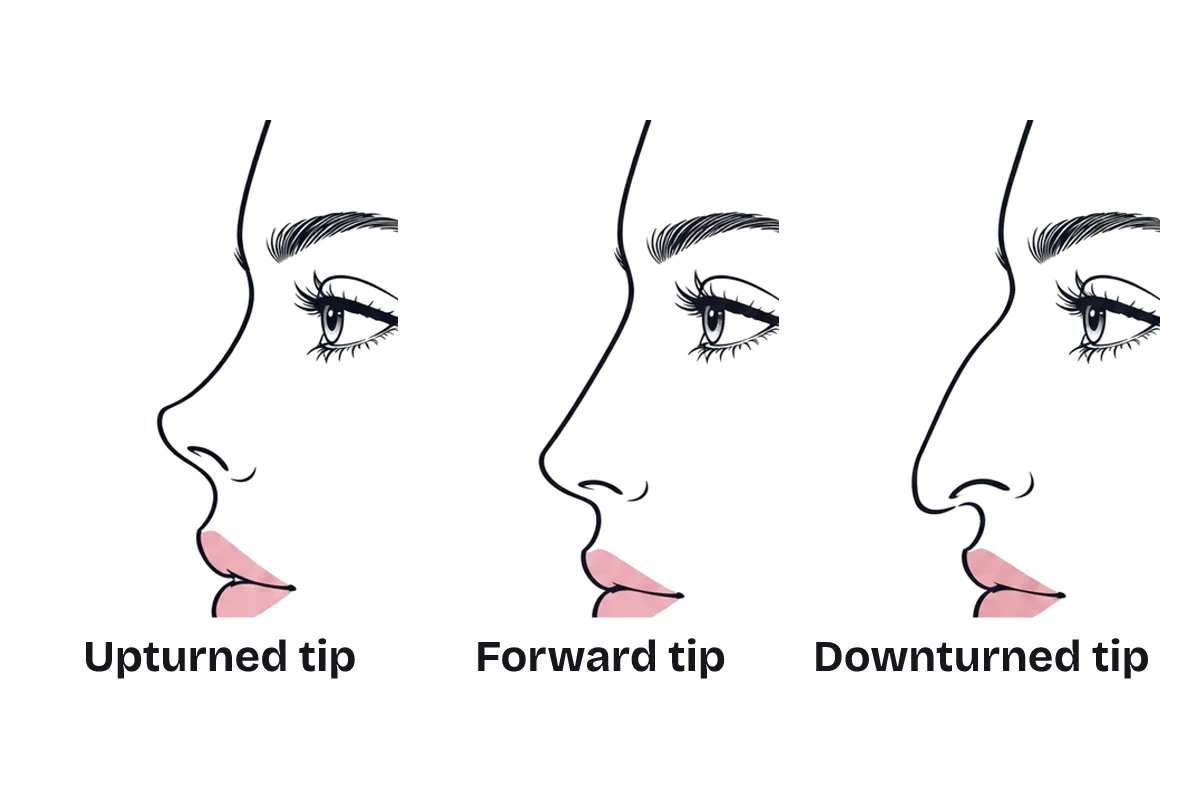
Your answers combine into a type. A straight bridge, forward tip and defined tip point to Greek. An outward curve plus a downward tip points to aquiline. A short, scooped bridge with an upturned tip points to snub or celestial.
Every nose type, with names
Greek (straight)
A straight bridge that runs in one clean line to a tip pointing forward, often with a shallow radix so the nose seems to continue from the forehead. The name comes from the profiles of classical Greek statues. See the Greek nose guide.
Roman
A high bridge that curves gently outward, usually most prominent in the upper half, with a tip that points forward or very slightly down. Its name refers to the profiles on Roman coins and portrait busts. See the Roman nose guide.
Aquiline (hooked)
A more pronounced outward arch, often with a tip that angles downward, giving the curved profile the old name aquiline (from the Latin for eagle) describes. “Hooked” is a casual term for the same shape. See the aquiline nose guide.
Button
A small nose with a rounded tip, usually on a short, straight or slightly scooped bridge. The tip often turns up a little. See the button nose guide.
Snub
Short overall, with a gently scooped bridge and a tip that turns clearly upward, so the nostrils show a little more from the front.
Celestial (upturned)
Similar to snub but usually longer, with a straight or softly scooped bridge that ends in a distinctly upturned tip. The two names are often used interchangeably.
Fleshy
A nose with a full, rounded tip and soft contours. The bridge can be straight, curved or scooped. When the tip is especially round and wide, it’s often called bulbous. Both describe a tip shape, which can come from the shape of the tip cartilage or thicker skin.
Wide, narrow and medium
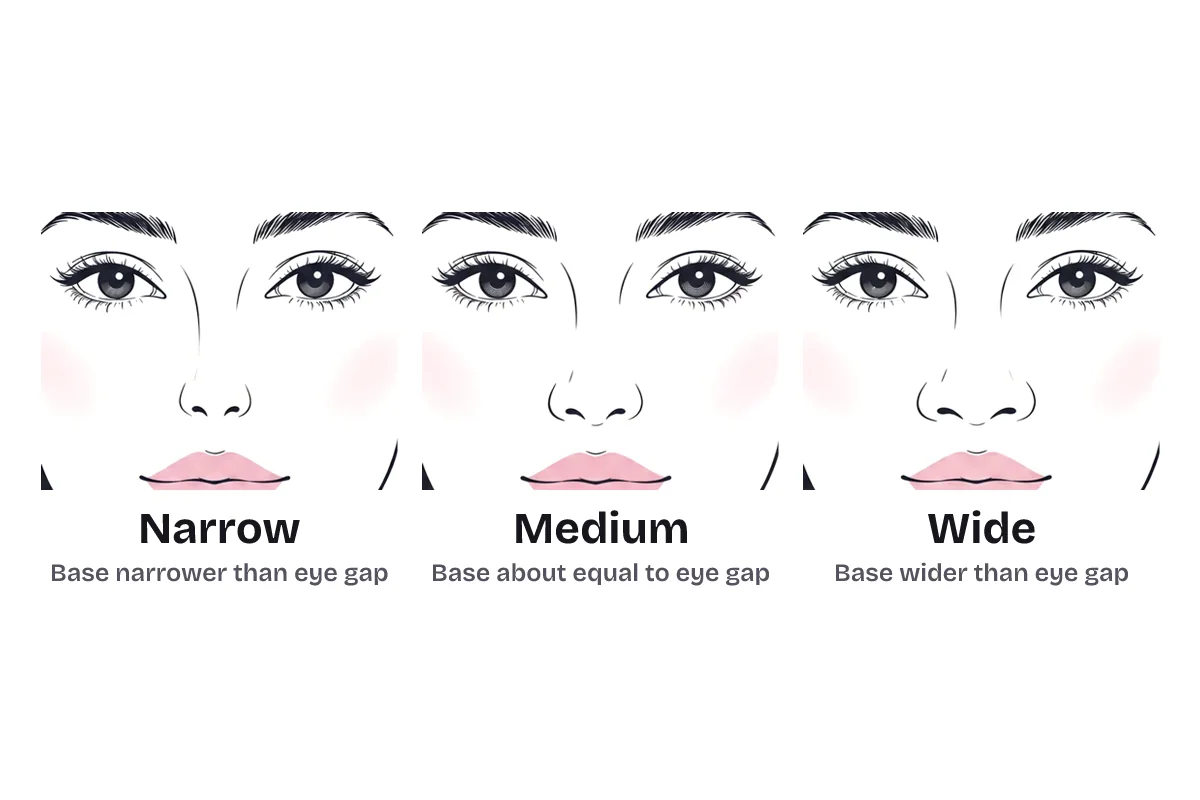
Width is a separate trait that combines with any of the profiles above. A narrow nose has a base noticeably narrower than the gap between your eyes, a medium nose is about equal, and a wide nose is broader. A Greek profile can be narrow or wide; so can a button nose.
Crooked and combination noses
A crooked nose bends to one side, which can be natural or come from an old injury. A combination nose simply mixes traits, such as a Roman bridge with a fleshy tip. Combination is the most honest description of a lot of noses.
About the names
Most nose names come from art history or plain description, not science. Greek and Roman refer to how sculptors carved profiles, celestial describes a tip pointing skyward, and aquiline borrows from Latin. We don’t name noses after ethnic groups, as some charts online do, because nose shapes vary widely within every population and those labels end up as stereotypes. Bridge, tip and width describe your nose more accurately anyway.
Styling by nose shape
Nose shape mostly matters in three everyday choices:
- Glasses. Fit comes first. The frame’s bridge should sit evenly on your nose without pinching or gaps. A low or scooped bridge (common with button, snub and celestial noses) often needs adjustable pads or a low-bridge fit so frames don’t slide; a high bridge (common with Roman and aquiline noses) usually suits keyhole or higher bridges.
- Hair. Sleek, pulled-back styles show off a strong profile. Soft layers and side-swept bangs draw the eye outward and soften it. Neither is better; it depends on what you want to highlight.
- Piercings. Nostril studs usually sit best in the natural crease where the wing of the nose meets the cheek, and a septum ring follows the columella. The individual guides show placements for each type.
Makeup contour is entirely optional. If you’d like to try it, the nose shape detector page has a starting-point table for each type.
Nose shapes for men
The same types apply to men’s noses, which tend to be a little larger on average, so a strong bridge stands out more in profile. For men, nose shape mainly affects glasses fit and how a beard balances the profile: a fuller beard adds weight at the jaw, which makes a prominent nose read as part of a strong profile rather than the focal point.
Why your nose looks different in photos
If your nose looks bigger in selfies than in the mirror, the camera is the reason. A lens close to your face magnifies whatever is nearest to it, and that’s your nose. A 2018 study found that photos taken about 30 cm (12 inches) away made the nasal base look around 30% wider than photos from 1.5 m (5 feet). Wide-angle front cameras exaggerate the effect. For checking your nose type, use a photo from arm’s length or further, ideally with the phone at eye level.
Noses also change slowly with age: the tip support weakens over decades, so the tip can sit a little lower and the nose can look slightly longer. Most people keep the same basic nose type for life.
Myths about nose shapes
- “There’s a perfect nose shape.” Preferences change between cultures and decades. Every nose type suits the face it’s on.
- “Nose shape reveals personality.” No evidence supports face-reading claims about noses.
- “Exercises can reshape your nose.” Bone and cartilage don’t change with exercises or devices.
- “Your nose type is your heritage.” Nose shapes vary enormously within every population. Describe the nose, not the person.
- “You have exactly one nose type.” Most noses are combinations. Two close matches is a normal result.
Find your nose type
The nose shape detector measures your front view on your device and pairs it with a quick profile picker, so you get your closest type, a runner-up and what defines each. For the rest of your features, see the face shapes guide and the eye shapes guide.
Frequently asked questions
What are the different types of noses?
The types most charts agree on are Greek (straight), Roman (curved, high bridge), aquiline (arched, tip angled down), button (small and rounded), snub (short, tip turned up), celestial (scooped, tip turned up) and fleshy (full, rounded tip). Longer lists of 12 or more add descriptive variations such as wide, crooked or combination noses.
How do I identify my nose type?
Look at your profile in a photo taken at eye level from about 1.5 m (5 feet) away. Check whether the bridge is straight, curves outward or dips in, and whether the tip points up, forward or down. Then check the width from the front against the gap between your inner eye corners. The nose shape detector measures the front view on your device and lets you pick your profile from drawings.
What's the rarest nose type?
There's no reliable data on how common each nose type is. The names are loose descriptions rather than measured categories, and most noses combine features of two types, so claims about the rarest one aren't based on evidence.
What is a common nose shape?
Straight and gently curved bridges are both very common, as are noses that combine features, such as a straight bridge with a slightly full tip. Because bridge, tip and width vary independently, there's no single typical nose.
What's the most feminine nose shape?
No nose shape is more feminine than another. Noses of every type are common in women and men, and ideas about which shapes look feminine change between cultures and decades. If you'd like a softer or more defined look, hair, brows and makeup change how the nose reads far more than its shape does.
Do nose types say where someone is from?
Nose shape varies a great deal within every population, so we don't label nose types by ethnicity or nationality. Names like Greek and Roman come from classical sculpture and describe a profile only. Describing a nose by its bridge, tip and width is more accurate and more useful.
Can you change your nose shape without surgery?
Not permanently. Nose exercises and shaping devices don't change bone or cartilage. Makeup contour, brow shape, hairstyles and glasses can change how your nose looks in person and in photos. Fillers and surgery are medical procedures to discuss with a qualified doctor.
Does nose shape change with age?
Somewhat. Over decades the tissues that support the tip tend to weaken, so the tip can sit a little lower and the nose can look slightly longer, while the skin thins. Most people's nose type stays recognizably the same.
Ready to check yours? The free nose shape detector takes about a minute, and your photo never leaves your device.
Open the nose shape detectorSources
- Anatomy, Head and Neck, Nose (StatPearls), NCBI Bookshelf, US National Library of Medicine
- Rhinoplasty (StatPearls), NCBI Bookshelf, US National Library of Medicine
- Nasal Distortion in Short-Distance Photographs: The Selfie Effect (JAMA Facial Plastic Surgery, 2018), PubMed, US National Library of Medicine
- The Ageing Nose: Challenges and Solutions (Current Otorhinolaryngology Reports, 2022), Springer