Eye Shapes: Every Eye Type and How to Tell Yours
The parts of the eye that decide your shape
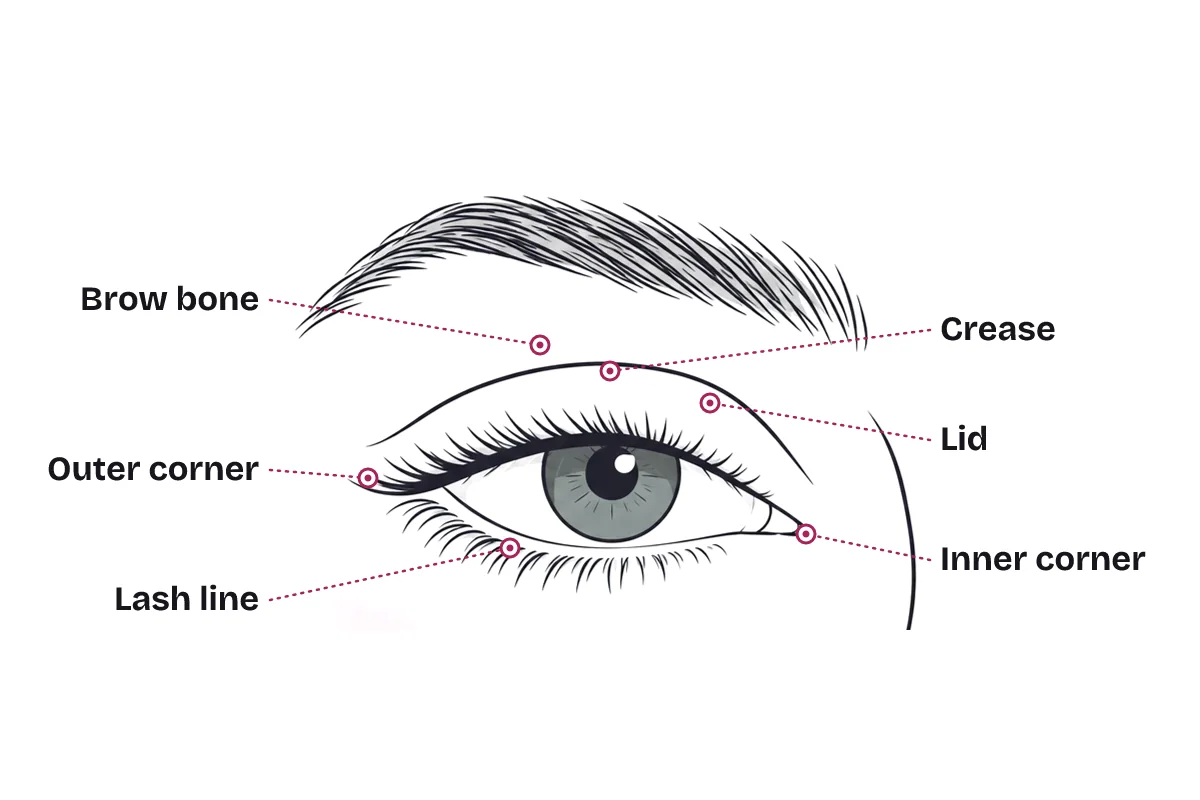
Eye types sound like a list of unrelated names, but they all describe a handful of landmarks you can see in a mirror:
- The crease is the fold in the upper lid, formed where the muscle that lifts the lid attaches to the skin (StatPearls). Whether it’s visible, covered or absent decides crease, hooded or monolid.
- The lid is the space between the crease and the lashes. How much of it shows changes where shadow and liner land.
- The inner and outer corners set the length of the eye and its angle. A line between them tells you if your eyes are upturned, straight or downturned.
- The brow bone decides depth. A prominent brow bone over eyes that sit further back is what makes eyes deep-set.
- The lash lines frame the iris. How much white shows between the iris and the lids separates almond from round.
How to tell your eye shape
The eye shape detector measures your eye outline, tilt and spacing from a photo on your phone, then asks three quick questions about your lids.
Open the eye shape detectorStand in daylight, look straight ahead and keep your brows relaxed (raising them changes your lids). Work through one trait at a time:
- Lid. Is there a clear crease with a band of lid below it? If a fold of skin hides the crease, your eyes are hooded. If there’s no crease at all, you have monolids.
- Outline. Look at your iris. If the lids meet it at the top and bottom, your eyes lean almond. If white shows above or below it, they lean round.
- Angle. Imagine a horizontal line through both inner corners. Outer corners above it mean upturned, on it mean straight, below it mean downturned.
- Depth. Turn your head a little to the side. If your brow bone clearly overhangs and your lids sit in shadow, your eyes are deep-set.
- Spacing. Compare the gap between your inner corners with the width of one eye. Noticeably less is close-set, noticeably more is wide-set.
Write down one answer for each trait. “Hooded, almond, slightly downturned” is a complete and very common eye type.
Eye shape types, explained
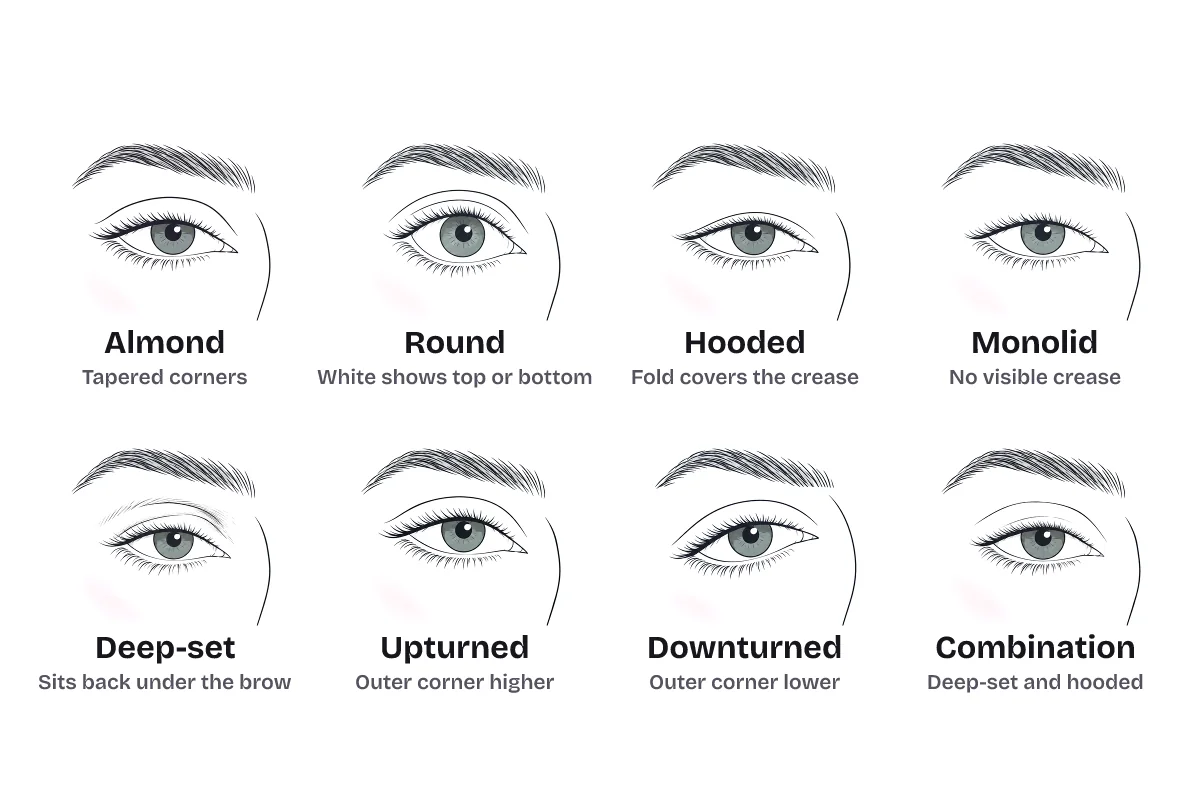
Almond
Almond eyes are longer than they are tall, with corners that taper to a point and lids that touch the iris at the top and bottom, so little or no white shows. The crease is usually visible. They’re often used as the neutral reference in makeup tutorials. See the almond eyes guide.
Round
Round eyes look taller in the center, with white visible above or below the iris when you look straight ahead. They read as open and bright. Liner that stretches past the outer corner lengthens them if you want a more elongated look; keeping liner close to the lashes keeps them wide.
Hooded
A soft fold of skin from below the brow sits over the crease and covers part or most of the lid when your eyes are open. Hooded lids are very common and often become more pronounced with age. The key is to apply makeup with your eyes open. See the hooded eyes guide.
Monolid
A monolid has no visible crease: the upper lid is smooth from the lashes to the brow. Monolids range from lids that show plenty of space to lids that partly cover the lash line. Shadow blended in a gradient from the lashes upward shows well. See the monolid eyes guide.
Deep-set
Deep-set eyes sit further back in the eye socket under a more prominent brow bone, so the lid area can look shadowed and the lashes can seem shorter. Light, reflective lid shades bring the eye forward. See the deep-set eyes guide.
Prominent
Prominent eyes sit further forward, so more of the lid and the eyeball shows and the eyes look large. It’s usually just bone structure. Matte, medium shadow on the lid and liner along the upper lash line give definition without adding shine to the most forward point.
Upturned and downturned
Upturned and downturned describe the angle from the inner to the outer corner. Upturned eyes lift at the outer corner, a trait some people call cat-like. Downturned eyes dip slightly at the outer corner, which can give a soft, gentle look. Straight eyes, with corners level, sit in between. See the downturned eyes guide.
Close-set and wide-set
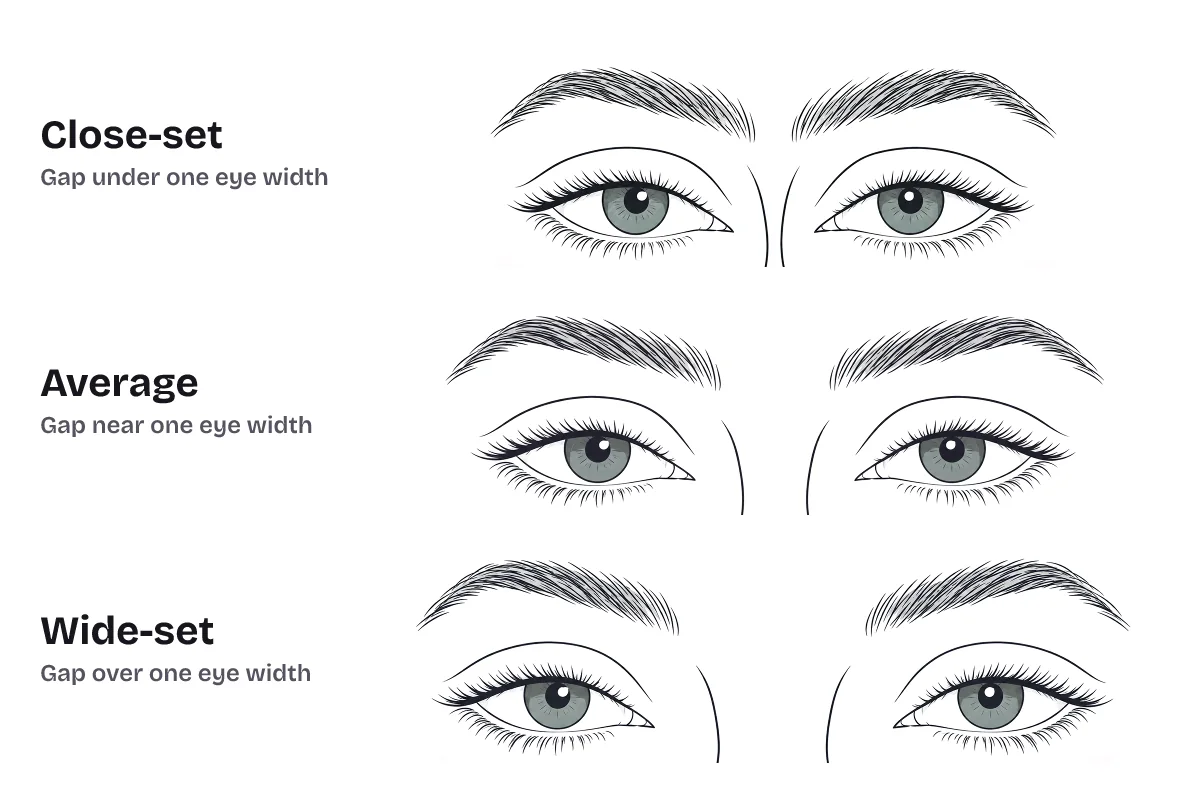
Spacing isn’t about shape at all, which is why it combines with every other trait. As a rule of thumb, the gap between the inner corners is about the width of one eye. Measured studies put the average adult inner-corner distance at roughly 30 to 31 mm. Close-set eyes have a noticeably smaller gap; wide-set eyes have a larger one.
Makeup can shift the balance either way. For close-set eyes, keep the inner corners light and put depth on the outer third. For wide-set eyes, bring a little color toward the inner corners and keep liner close to the nose side of the lash line.
Doe, siren, fox and cat eyes: looks, not shapes
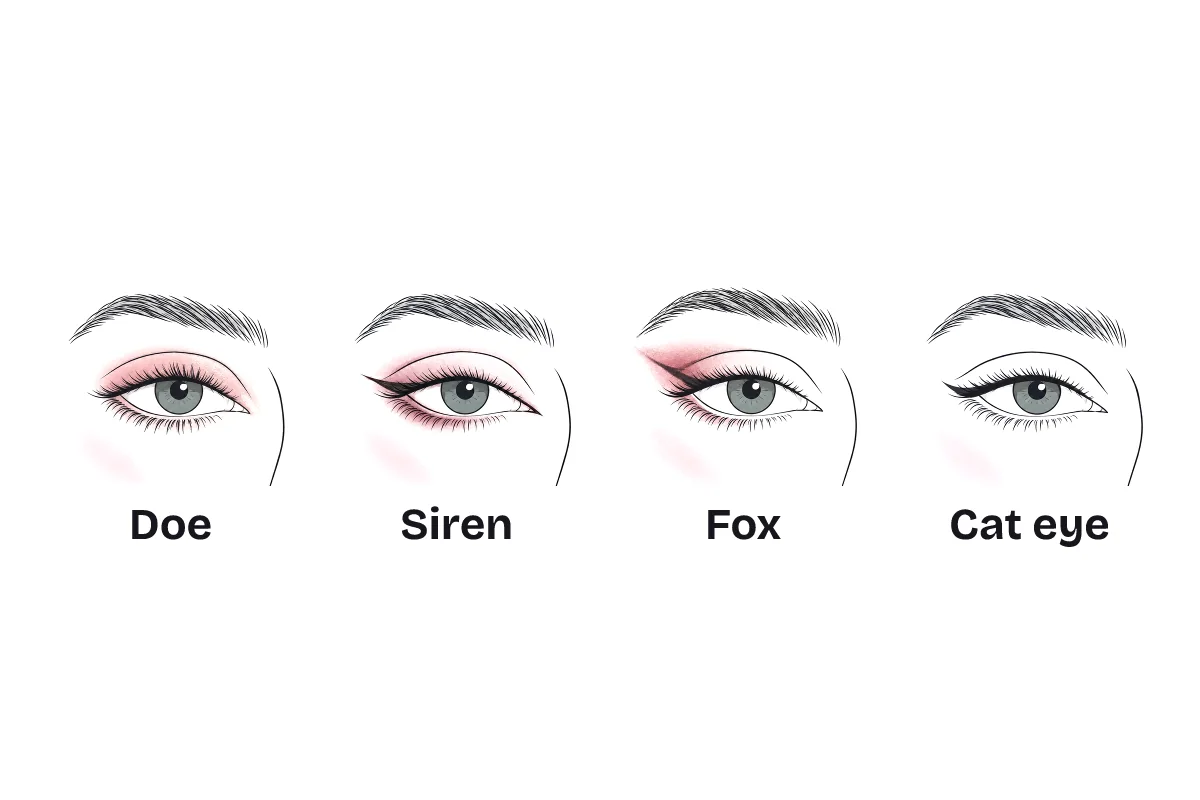
Social media added a second set of names that often appear in eye type lists. They describe aesthetics, and any of them can be created on any eye with makeup:
- Doe eyes are wide, rounded and soft, with level or slightly downturned corners and lots of lash. Round eyes naturally lean this way. See doe eyes.
- Siren eyes are long and lifted, with liner that elongates the outer corner and a smoky, sultry finish. Almond and upturned eyes lean this way. See siren eyes.
- Fox eyes take the lift further, with the outer corner and brow tail pulled up toward the temples. See fox eyes.
- Cat eye is the classic winged liner look, a sharp flick extending from the outer corner.
Knowing your natural shape tells you which look needs the least work, and where to adjust liner placement to get the others.
Makeup by eye type at a glance
The aim of eye makeup placement is simple: put color where it will show when your eyes are open, and use lighter or deeper shades to change how open, long or lifted the eye looks.
| Eye type | Where shadow shows best | Liner idea | Lash focus |
|---|---|---|---|
| Almond | Lid and crease, any placement | Any style; a short flick suits most | Even all along |
| Round | Deeper shade on the outer third | Extended outer line to lengthen | Outer corners |
| Hooded | Just above the natural crease, eyes open | Wing mapped with eyes open | Curl hard; waterproof formula |
| Monolid | Gradient from lash line up | Thicker toward the outer corner | Heated curler, light mascara |
| Deep-set | Light, bright shades on the lid | Fine line or smudged shadow | Curl well so lashes lift into view |
| Prominent | Matte, medium shades | Defined upper line | Moderate length |
| Upturned | Balance with depth on the lower outer lashes | Follow the natural lift | Lower outer lashes |
| Downturned | Blend up and out, not down | Wing angled toward the brow tail | Outer upper lashes |
None of these are rules. They’re ways to get a specific effect, and the right look is the one you enjoy wearing.
Lip liner follows the same idea, and the lip shape detector shows where yours will look most natural.
Eye shapes for men
The same eye types apply to men, and the same mirror checks work. For men the practical uses are grooming and glasses: brows that are tidy rather than heavy keep hooded and deep-set eyes looking open, and frames whose top rim sits close to the brow line suit most eye types. If your eyes are close-set, frames with a slightly wider bridge balance the spacing; if they’re wide-set, a narrower bridge does the opposite.
How eye shape changes over time
Your eye type isn’t fixed. Measurements of aging eyelids show the upper lid gaining looser skin and fullness at the outer side over the years, which is why many people move from a visible crease toward hooded. The brow tends to descend, adding to the hood, and the outer corners can look more downturned. Depth changes too, as fat around the eye shifts and the eye socket slowly widens. None of this is a problem to fix, but it’s a good reason to recheck your eye shape every few years and update where you place your makeup.
Myths about eye shapes
- “Everyone has one of six eye shapes.” Most people combine several traits, and the boxes blur into each other.
- “Your eye shape reveals your personality.” There’s no evidence for it.
- “Some eye shapes are better than others.” No eye type is better or worse. Each simply puts the lid, crease and corners in different places.
- “Monolids and hooded eyes are the same.” Hooded eyes have a crease that’s covered by a fold; monolids have no crease.
- “You need surgery to change your eye shape.” Makeup, lashes and brow shaping change how your eyes look day to day. Surgery is a separate medical decision, not a styling step.
Find your eye type
The eye shape detector checks your outline, tilt and spacing from a photo and combines them with your answers about your lids, all on your device. Pair it with the face shapes guide and the nose shapes guide to see how your features work together.
Frequently asked questions
What are the most common eye shapes?
Almond, round, hooded and monolid are the eye types you'll see in almost every chart, and hooded lids become more common with age. Upturned, downturned, deep-set, close-set and wide-set describe angle, depth and spacing, and they combine with those four rather than replacing them.
What are the four types of eyes?
There's no official list of four. Charts that use four usually mean almond, round, hooded and monolid. A more useful way to think of it is four traits: lid (crease, hooded or monolid), outline (almond or round), angle (upturned, straight or downturned) and position (deep-set, close-set or wide-set).
What is the rarest eye shape?
No reliable study ranks eye shapes by how common they are, so any claim about the rarest one is a guess. How common a trait is also varies a lot between families and age groups, and eye shape blends from one type to the next rather than falling into neat boxes.
How can I tell my eye type?
Look straight into a mirror in daylight with a relaxed face. Check whether you can see a crease, whether white shows above or below your iris, whether your outer corners sit higher or lower than your inner corners, and how far apart your eyes are compared with one eye's width. The eye shape detector measures the outline, tilt and spacing from a photo and asks about your crease.
What is the most attractive eye shape?
There isn't one. Attractiveness is personal and changes between cultures and decades, and every eye type is common among people widely seen as beautiful. Eye shape is useful for knowing where liner and shadow will show, not for ranking.
Do eye shapes have meanings?
No. Readings that link eye shape to personality, such as almond eyes meaning a calm nature, aren't supported by any evidence. They're entertainment. Eye shape tells you about anatomy and makeup placement, nothing about character.
Can your eye shape change with age?
Yes. Over the years the brow tends to descend and the upper lid gains looser skin, so many people become more hooded, and the outer corners can look more downturned. The bony eye socket also changes slowly. These are normal changes, though a lid that droops quickly or on one side only should be checked by an eye doctor.
Are doe, siren and fox eyes real eye shapes?
Doe, siren and fox eyes are makeup looks and aesthetics rather than anatomy. Some natural shapes resemble them (a rounder eye reads as doe, a longer, lifted eye reads as siren), but any of them can be created on any eye shape with liner, shadow and brow shaping.
Ready to check yours? The free eye shape detector takes about a minute, and your photo never leaves your device.
Open the eye shape detectorSources
- Anatomy, Head and Neck: Eyelid (StatPearls), NCBI Bookshelf, US National Library of Medicine
- Normal interpupillary, inner canthal distance and outer canthal distance values, PubMed Central, US National Library of Medicine
- Telecanthus, EyeWiki, American Academy of Ophthalmology
- Quantitative 3-dimensional Geometry of the Aging Eyelids (Plastic and Reconstructive Surgery Global Open, 2019), PubMed Central, US National Library of Medicine
- Changes in the Facial Skeleton With Aging: Implications and Clinical Applications in Facial Rejuvenation (Aesthetic Plastic Surgery, 2012), PubMed Central, US National Library of Medicine
- Proptosis (Bulging Eyes), Cleveland Clinic