Nose Shape Detector: What Is My Nose Shape?
Nose shape from a front photo plus a quick profile pick: the photo measures width and tip, and you choose your side view.
Private by design. Your photo is analyzed on your device and never uploaded, saved or shared.How this works
Choose a clear, front-facing photo
Your photo stays on this device. Nothing is uploaded.
For the most accurate result
- Face the camera straight on, at eye level
- Hold the phone at arm’s length or further (close-ups make noses look wider)
- Relaxed face, no smile
- Soft, even light from the front
Nose types describe three things: the line of the bridge seen from the side, the direction and size of the tip, and the width of the nose from the front. Common names include Greek (straight), Roman, aquiline, button, snub, celestial and fleshy. They’re descriptive labels only: no nose type is better than another, and none belongs to any group of people.
Find your nose shape
The tool above works in two ways:
- Front photo plus profile picker. Your photo measures nose width, length and tip width. Then you choose your side profile from simple drawings, because a front photo can’t show the shape of the bridge.
- Picker only. Skip the photo and just answer three profile questions.
You get your closest nose type, the next closest, what defines it and optional styling ideas, including how to choose glasses that fit.
How we describe noses: bridge, tip and width
Anatomists describe the outside of the nose by its parts (StatPearls):
- Bridge (dorsum): the line from between your brows down to the tip. From the side it can be straight, curve outward (a hump), or dip slightly inward.
- Tip: the rounded end of the nose. It can point up, straight ahead or slightly down, and be small, defined or full.
- Wings (alae): the curved sides around the nostrils. Their spread sets the nose’s width from the front.
The detector measures width against the space between your inner eye corners (a common reference in facial proportion studies, where the two are often similar), length against the lower half of your face, and tip width against overall nose width. It reports each as narrow, medium or wide compared with an average face, using the cut-offs listed in the numbers behind each result.
Nose types the detector uses
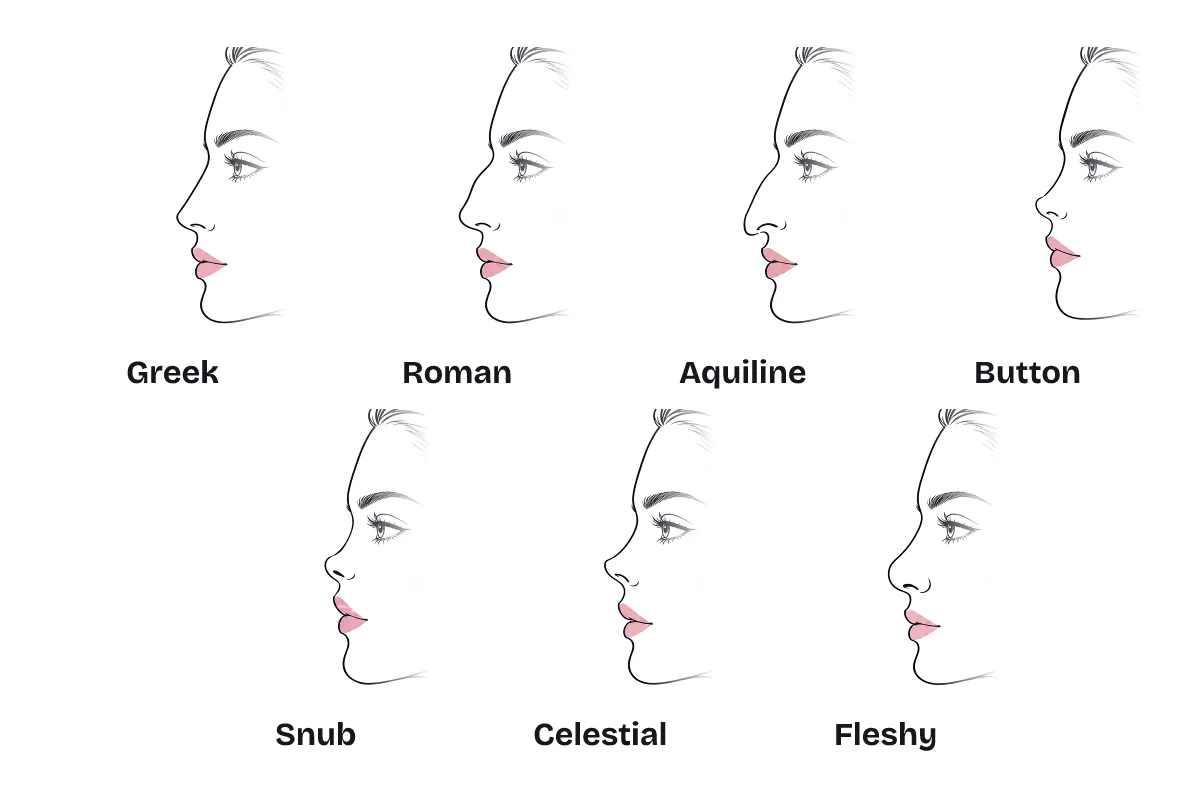
Your result names the closest of these types and a runner-up:
- Greek: a straight line from brow to tip.
- Roman: a high bridge that bows gently outward.
- Aquiline: a stronger arch, often with the tip angled down.
- Button: small, with a round tip.
- Snub: short, with a tip that lifts.
- Celestial: a scooped or straight bridge ending in a lifted tip.
- Fleshy: a full, soft tip on any bridge.
Width and tip size are reported separately, as narrow, medium or wide. For every nose type with pictures and how to tell them apart, see the complete guide to nose shapes.
How to identify your nose type from the side
A side view tells you the most. Ask someone to take a photo of your profile at eye level from about 1.5 m (5 feet) away, or use two mirrors.
- Trace the bridge from between your brows to the tip. Is the line straight, does it bulge outward, or does it dip in?
- Look at the tip direction. Imagine a horizontal line through the tip. Does the underside of your nose angle up, sit level, or angle down?
- Look at the tip size. Is it small and rounded, clearly defined, or full?
Then pick the matching drawings in the tool. If two answers feel equally true, pick either: you’ll see your runner-up type too.
Why photos change how your nose looks
Close-up selfies are the biggest reason people feel their nose looks different in photos. Because the nose is the part of the face nearest the lens, a phone held close enlarges it more than anything else. One study found that a selfie taken from about 30 cm (12 inches) makes the base of the nose look around 30% wider than a photo from 1.5 m (5 feet) (Ward and colleagues, 2018).
The selfie effect is why the detector asks for a photo at arm’s length or further, and why your mirror (which you see from a distance) often looks different from your selfies.
Does nose shape change with age?
A little, for most people. Over the decades the structures that support the tip tend to soften, so the tip can droop slightly and the nose can look a bit longer, while the skin becomes thinner (Current Otorhinolaryngology Reports, 2022). If your result changes over the years, that’s normal.
Contouring and glasses by nose shape
Makeup for the nose is completely optional, and most people never contour it. If you’d like to, these are the usual starting points:
| Nose type | Optional makeup idea | Glasses fit |
|---|---|---|
| Greek | A soft highlight down the center of the bridge | Most bridges fit; keyhole bridges sit comfortably |
| Roman | Matte highlight above and below the curve, not on it | A slightly higher bridge or adjustable pads |
| Aquiline | A little blush under the tip for lift | Adjustable nose pads keep frames level |
| Button | A dot of highlight on the tip | Nose pads or a low-bridge fit so frames don’t slide |
| Snub, celestial | A thin highlight from bridge to tip | Low-bridge fit or adjustable pads |
| Fleshy | Highlight at the tip center, soft shading at the sides | A slightly wider bridge |
Glasses fit is where nose shape matters most in daily life. The bridge of a frame should rest evenly on your nose without pinching or leaving gaps, and your eyes should sit near the center of each lens. If frames always slide down, look for adjustable nose pads or a low-bridge fit.
Frequently asked questions
How do I identify my nose shape?
Look at your nose from the side and from the front. From the side, notice whether the bridge is straight, curves outward or dips inward, and whether the tip points up, forward or down. From the front, compare its width with the space between your eyes. The detector above measures the front view from a photo and lets you pick your profile from drawings.
What is the most desirable nose shape?
There isn't one. Preferences vary between people, cultures and eras, and every nose type is common among people widely considered attractive. The useful question is how to style what you have, such as glasses that fit your bridge.
Is there a free nose shape detector?
Yes. This one is free with no sign-up, and the photo step runs in your browser, so your picture is never uploaded. You can also skip the photo and use the profile picker only.
Why do I pick my profile instead of adding a side photo?
A front photo can measure width and tip, but the shape of the bridge only shows from the side, and side photos are hard to measure consistently at home. Picking the closest profile drawing is quicker and more reliable.
Can I find my nose shape without a photo?
Yes. Choose Picker only and answer three questions about your bridge, tip direction and tip size. You'll get the same kind of result, without the width measurement.
Sources
- Anatomy, Head and Neck, Nose (StatPearls), NCBI Bookshelf, US National Library of Medicine
- Nasal Distortion in Short-Distance Photographs: The Selfie Effect (JAMA Facial Plastic Surgery, 2018), PubMed, US National Library of Medicine
- The Ageing Nose: Challenges and Solutions (Current Otorhinolaryngology Reports, 2022), Springer Nature