Eye Shape Detector: What Is My Eye Shape?
Eye shape in about a minute: a photo measures your eye outline and tilt, and three quick questions about your eyelid crease do the rest.
Private by design. Your photo is analyzed on your device and never uploaded, saved or shared.How this works
Choose a clear, front-facing photo
Your photo stays on this device. Nothing is uploaded.
For the most accurate result
- Look straight into the camera with a relaxed face
- Keep your eyes naturally open: don’t widen them or squint
- Take off glasses and pull hair away from your eyes
- Use soft, even light from the front
Your eye shape describes the outline of your eyes, the way your upper eyelid folds, how your eyes sit under your brows and the angle from the inner to the outer corner. The main types are almond, round, hooded, monolid, deep-set, upturned and downturned, and most people are a mix of two. Knowing yours makes eyeliner, eyeshadow and lash placement much easier.
Find your eye shape in about a minute
Choose how you want to check in the tool above:
- Choose a photo or use your camera. We measure how open your eyes are, the angle from inner to outer corner and the space between your eyes. Then you answer three short questions about your eyelids.
- Quiz only. Six questions with drawings, no photo at all.
You get one or two main eye types, extra details (like “slightly downturned” or “wide-set”), the closest makeup look and liner, shadow and lash ideas for your shape.
Why eye shape needs two steps
Face-mapping software (MediaPipe Face Landmarker) is very good at finding the corners of your eyes and the edges of your lids. It is not good at seeing a crease that is hidden under a fold of skin, or telling how deep your eyes sit, because both depend on shadows and fine skin detail that a single photo doesn’t capture well.
So we split the job. The photo handles what it measures reliably:
- Openness: eye height compared with eye width, which separates round from almond.
- Corner angle: the tilt of the line from your inner to your outer corner, which separates upturned, straight and downturned.
- Spacing: the gap between your inner corners compared with the width of each eye.
You answer what a photo can’t judge: whether you can see a crease, how much lid shows, and whether your eyes sit back under your brow bone. Combining both gives a more honest result than a photo alone. The exact cut-offs for round, upturned, downturned, close-set and wide-set are published in the numbers behind each result.
Eye shapes the detector can find
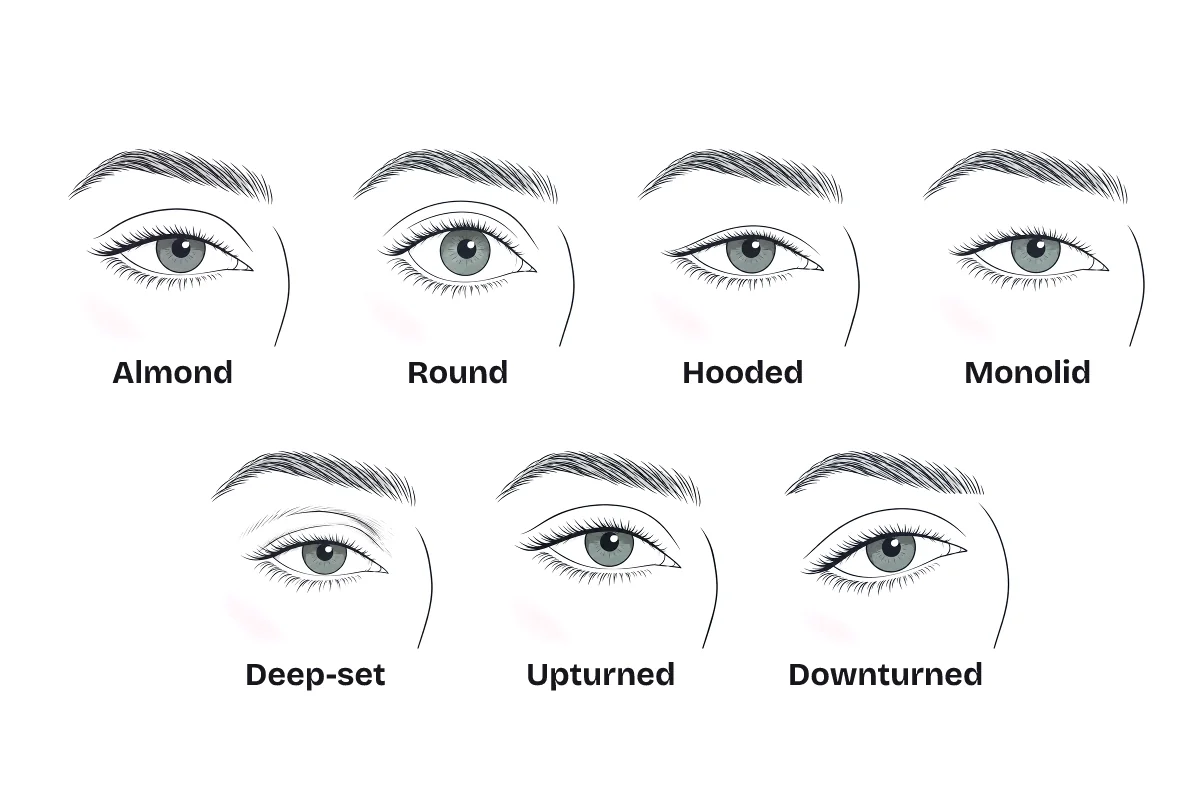
Your result combines up to two main types with extra details such as tilt and spacing:
- Lid: visible crease, hooded or monolid.
- Outline: almond (lids meet the iris) or round (white shows above or below).
- Depth: deep-set or not.
- Tilt: upturned, straight or downturned.
- Spacing: close-set, average or wide-set.
You’ll also see which makeup look your natural shape is closest to: doe, siren or fox. For every eye type explained in depth, with how to tell them apart, see the complete guide to eye shapes.
How to identify your eye shape in a mirror
Stand in daylight facing a mirror, relax your face and look straight ahead without raising your eyebrows.
- Find the crease. If you can see a clear fold line with a band of lid below it, you have a visible crease. If skin covers most of the lid, your eyes are hooded. If there’s no crease, you have a monolid.
- Check the white. If white shows above or below the iris, your eyes lean round. If the lids touch the iris, they lean almond.
- Draw an imaginary line across both inner corners. Are the outer corners above it (upturned), on it (straight) or below it (downturned)?
- Check the depth. Turn slightly to the side. If your brow bone clearly overhangs and your eyes sit back, they’re deep-set.
Is my eye round or almond?
Round or almond is the most common question, and many eyes sit right on the line. The quickest test is the white of the eye: with a relaxed, straight-ahead gaze, round eyes show white above or below the iris, while almond eyes don’t. Height helps too. Round eyes look about as tall as they are wide in the center, and almond eyes are clearly longer than tall. In the detector, the measurement table shows your eye height compared with its width next to an average face, so you can see which side of the line you’re on.
Can you have more than one eye shape?
Yes, and most people do. Hooded almond, round and slightly downturned, or deep-set and hooded are all common combinations. That’s why the detector gives you up to two main types plus extra details. It’s also normal for your two eyes to differ slightly, and for lids to become more hooded with age as skin loses firmness.
Makeup starting points by eye shape
| Eye shape | Liner | Shadow | Lashes |
|---|---|---|---|
| Almond | Any style, from tight line to wing | Mid shade in the crease, light on the lid | No special mapping needed |
| Round | Extend past the outer corner | Deeper shade on the outer third | Longer at the outer corners |
| Hooded | Draw with eyes open; try a “bat wing” | Crease shade just above the natural crease | Curl well; waterproof mascara |
| Monolid | Thicker toward the outer corner | Gradient, darkest at the lash line | Heated curler, light formula |
| Deep-set | Thin, or smudged shadow | Light, bright lid shades | Curl and coat to reach forward |
| Downturned | Wing angled toward the brow tail | Blend up and out | Focus on outer lashes |
The table gives options, not rules. Every eye shape can wear any look: the tips just show where to place things to get the effect you want.
Frequently asked questions
How do I identify my eye shape?
Check three things in a mirror with a relaxed face: whether you can see a crease on your upper lid, how much white shows around the colored part of your eye, and whether your outer corners sit higher, level or lower than your inner corners. The detector above measures the outline and angle from a photo and asks you about the crease.
Is my eye round or almond?
Look straight ahead. If your upper and lower lids touch the top and bottom of your iris and your eye is clearly longer than it is tall, it's almond. If you can see a little white above or below the iris and the eye looks open and circular, it's round. Plenty of eyes sit in between.
Is there a free eye shape detector?
Yes. This one is free with no sign-up, and it runs entirely in your browser, so your photo is never uploaded. It measures your eye outline, tilt and spacing on your device, then asks three quick questions about your lids.
Can I find my eye shape without a photo?
Yes. Choose the quiz instead of a photo and answer six picture-based questions about your crease, lid space, eye outline, corners and depth. It's a rougher guide than a photo measurement, and the result says so.
Why does the eye shape test ask about my eyelids?
Because a photo can't reliably see a crease hidden under a fold of skin, or how deep your eyes sit. The photo measures what it can (openness, tilt and spacing) and your answers cover the rest, which gives a more honest result than guessing from the image.
Sources
- Anatomy, Head and Neck: Eyelid (StatPearls), NCBI Bookshelf, US National Library of Medicine
- What Is Ptosis?, American Academy of Ophthalmology
- Dermatochalasis, EyeWiki, American Academy of Ophthalmology