Face Shapes: The 7 Types and How to Find Yours
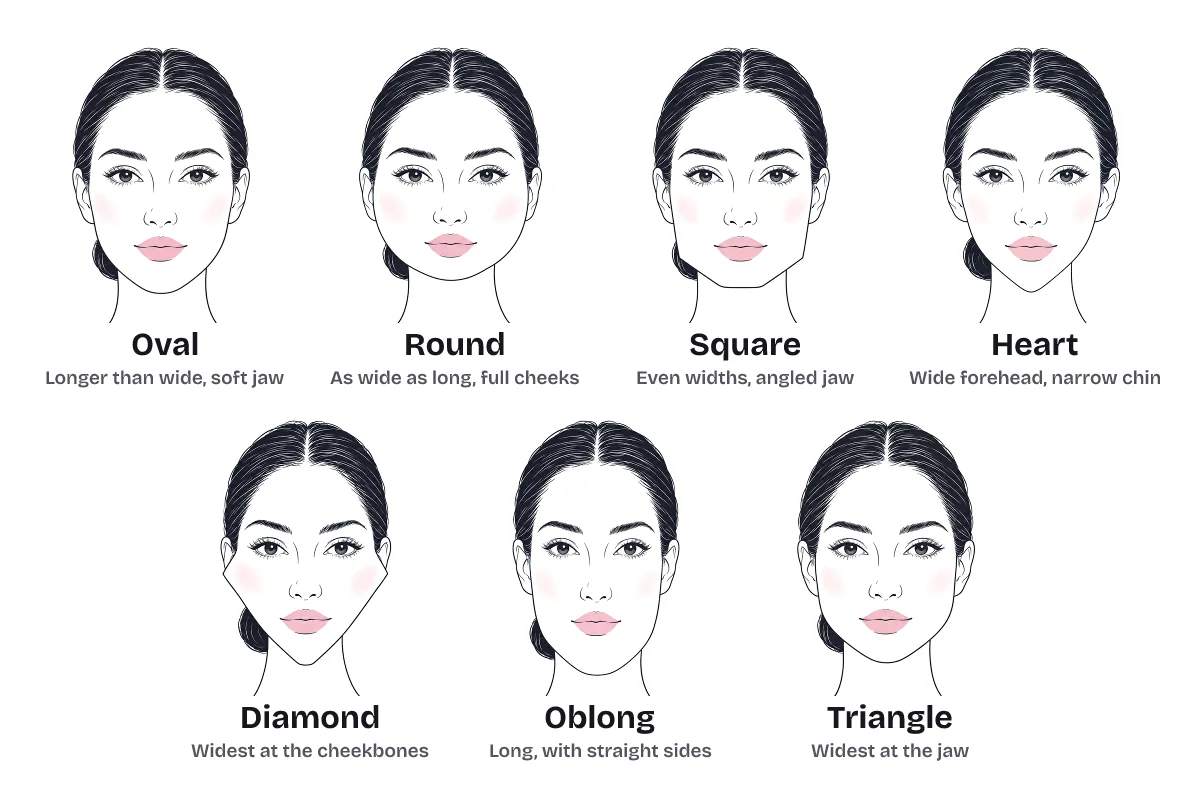
The 7 types of face shapes at a glance
Every face shape is a combination of two proportions and one detail: length compared with width, which of the three widths (forehead, cheekbones, jaw) is largest, and whether the jaw meets the chin in a curve or a corner. This table puts all seven side by side.
| Shape | Length vs width | Widest part | Jaw and chin | Full guide |
|---|---|---|---|---|
| Oval | Moderately longer | Cheekbones | Curved jaw, rounded chin | Oval face shape |
| Round | About equal | Cheeks | Soft, full jaw | Round face shape |
| Square | About equal | All three similar | Defined, angled corners | Square face shape |
| Heart | Moderately longer | Forehead | Narrow jaw, pointed chin | Heart face shape |
| Diamond | Moderately longer | Cheekbones, clearly | Narrow forehead and jaw | Diamond face shape |
| Oblong | Clearly longer | All three similar | Often straight sides | Oblong face shape |
| Triangle | Moderately longer | Jaw | Broad jaw, narrower forehead | Triangle face shape |
A few names overlap. Oblong is also sold as “rectangle” or “long”, triangle as “pear”, and heart as “inverted triangle”. They describe the same outlines.
How do I tell my face shape?
Prefer to skip the mirror? The face shape detector measures your outline from a photo, right on your phone, and shows which two shapes you're closest to.
Open the face shape detectorTie your hair back, face a mirror (or a photo taken from arm’s length at eye level) and keep a relaxed expression. Then work through these in order:
- Is your face clearly longer than it is wide? Compare the distance from hairline to chin with the width across your cheekbones. About the same points to round or square. Clearly longer, with a straight-sided look, points to oblong. Somewhere in between leaves oval, heart, diamond and triangle in play.
- Where is it widest? If your forehead is the widest part, think heart. If your cheekbones stick out past both forehead and jaw, think diamond (or oval when the difference is gentle). If your jaw is the widest part, think triangle.
- Curve or corner at the jaw? Run a finger along your jawline. A smooth curve into the chin suits oval and round. A noticeable angle below each ear suits square, and often oblong and triangle too.
- Check the chin last. A pointed or narrow chin supports heart and diamond. A broad, flat chin supports square and triangle.
If two shapes still fit, that’s a real answer, not a failed test. Read both guides and take the advice that suits your hair.
Measure across the cheekbones first
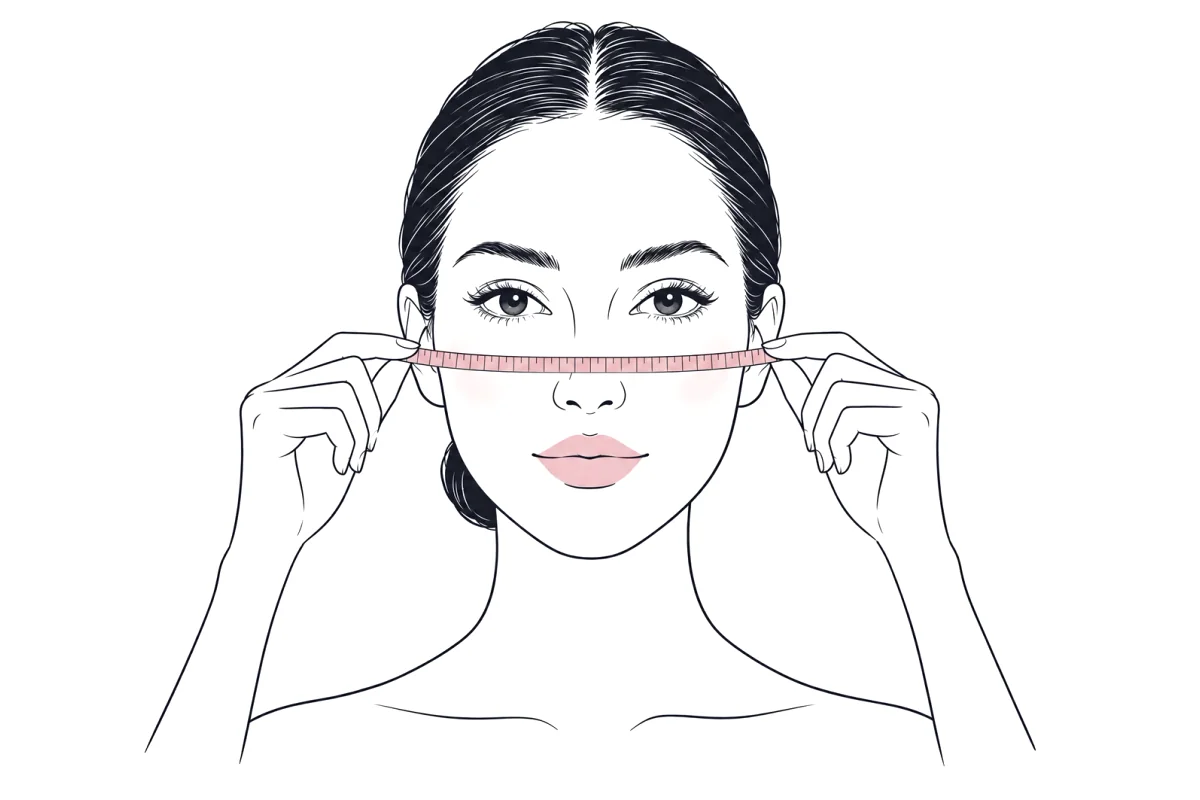
If the mirror leaves you unsure, numbers help. Your cheekbone width is the most useful single measurement, because the other three are read against it:
- Face length ÷ cheekbone width. About 1.3 or less suggests round or square. About 1.4 to 1.5 is the moderate range most oval, heart, diamond and triangle faces fall into. About 1.6 or more leans oblong.
- Forehead and jaw compared with cheekbones. If both are clearly narrower, you’re in diamond territory. If the forehead matches the cheekbones and the jaw is narrower, heart. If the jaw is wider than the forehead, triangle.
The ranges above come from the rules the detector uses, but they’re guides, not hard cutoffs, and a tape measures a curved face, so small differences of a centimeter or so don’t mean much. The face shape detector’s “No photo” mode takes your four numbers and does the comparison for you, with step-by-step instructions for where to place the tape.
The mirror trace, for a quick visual check
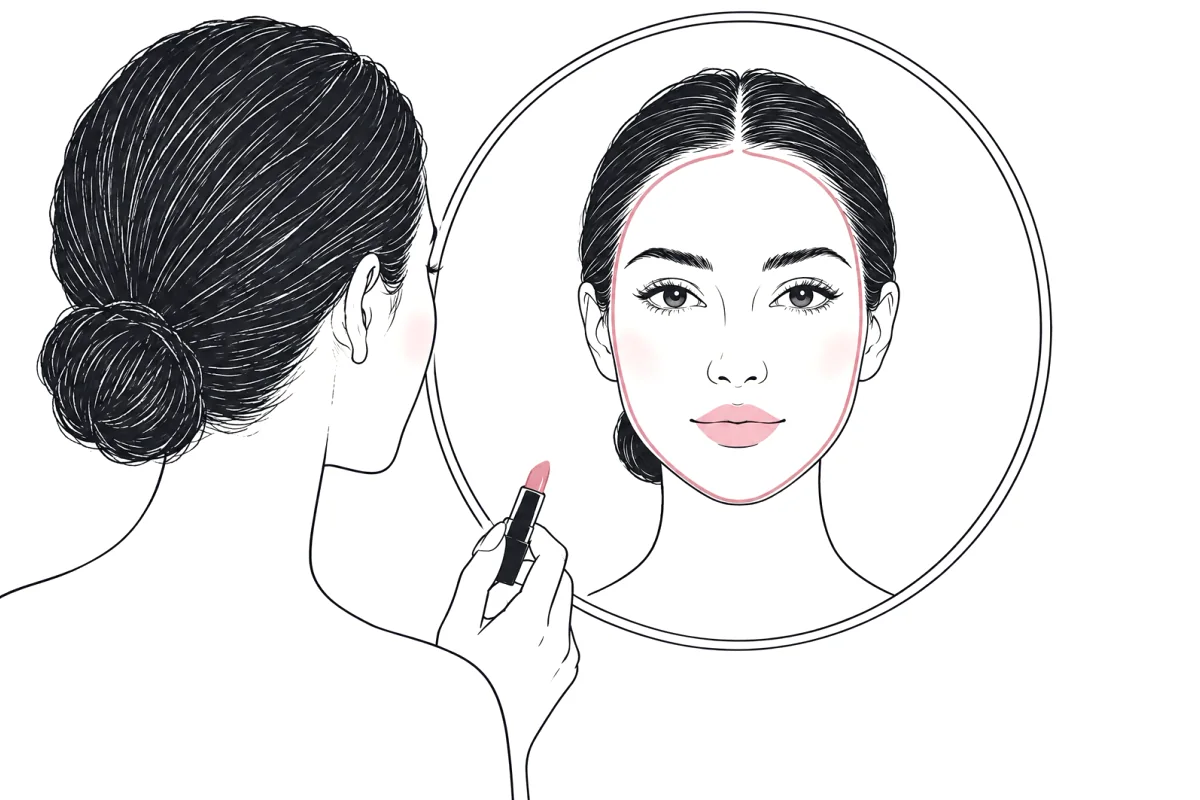
Some people find shapes easier to judge than numbers. Tracing your reflection with an old lipstick or a washable marker turns your face into a simple outline you can compare with the chart at the top of this page. Close one eye while you trace so the line doesn’t wobble, and keep your head still. The trace is good at showing the overall shape (long or short, curved or angular) and less good at small width differences, so use it to narrow things down to two candidates.
Face shapes that get mixed up
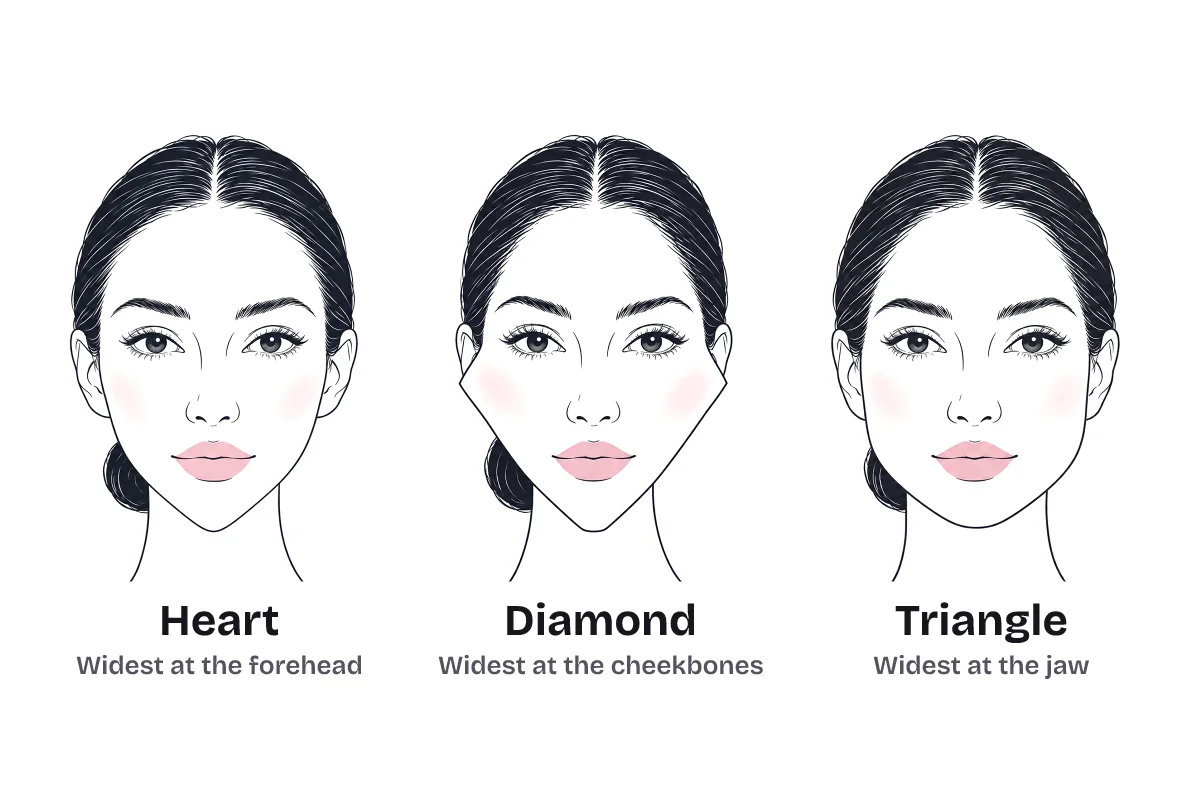
Most confusion happens between pairs that share one trait and differ in another.
Oval or oblong?
Both are longer than they are wide. An oval face curves in gently below the cheekbones, so the jaw is a little narrower than the cheeks. An oblong face keeps a similar width from temples to jaw, which makes the sides look straight. If your face looks long in photos and your jaw is nearly as wide as your cheekbones, oblong is the better fit.
Round or square?
Both are about as wide as they are long. The difference is the jaw. Round faces curve smoothly from cheek to chin; square faces turn a visible corner below each ear and often have a flatter chin. Clenching your teeth and feeling for the corner of the jaw makes it easier to judge.
Heart, diamond or triangle?
All three are defined by one wide area. Heart is widest at the forehead and tapers to the chin. Diamond is widest at the cheekbones, with a forehead and jaw that are both noticeably narrower. Triangle is the reverse of heart: the jaw is the widest part and the forehead the narrowest.
Oval or diamond?
Both are widest at the cheekbones. Diamond cheekbones are clearly more prominent, and the forehead at the temples is narrower. If the step down from cheekbones to forehead is small, you’re closer to oval.
What is the rarest face shape?
There’s no reliable data on how common each face shape is, because there’s no agreed way to measure them and most faces fall between two types. Diamond and triangle are often described as less common, but that’s an impression rather than a measured fact. Your own shape is easy to check either way: the three questions above take a minute.
What suits each face shape
Styling by face shape is mostly about balance: adding a little width where a face is narrow, or a little length where it’s short. You don’t have to follow it. These are starting points, and the linked guides go into detail.
| Shape | Hair starting point | Glasses starting point | Brows |
|---|---|---|---|
| Oval | Almost any length; choose by hair texture | Frames about as wide as the cheekbones | Soft natural arch |
| Round | Height at the crown, layers below the chin | Rectangular or angular frames | Higher, defined arch |
| Square | Soft layers and waves around the jaw | Round, oval or cat-eye frames | Rounded arch |
| Heart | Volume at chin level, side-swept bangs | Bottom-heavy or rimless frames | Soft, rounded arch |
| Diamond | Fringes, or fullness at the jaw | Oval, cat-eye or browline frames | Curved, not too high |
| Oblong | Bangs and width at the sides | Deep or oversized frames | Straighter, longer brows |
| Triangle | Volume at the crown and temples | Browline or cat-eye frames | Fuller, longer brows |
Your hair texture, features and lifestyle matter as much as your outline. Curly hair adds width wherever it sits, a strong brow changes how a face reads, and the “right” cut is the one you’ll actually wear.
Face shapes for men
The same seven shapes apply to men, though men’s faces are more often described with square, oblong and triangle jaws, and a beard can change which shape a face reads as. A full beard widens and lengthens the lower face; a short, squared beard adds corners to a round jaw. The face shapes for men guide covers haircuts, beards and frames for each shape.
Why your face shape can change
A face shape isn’t fixed for life. Gaining or losing weight changes fullness in the cheeks and under the jaw, which can move a face between round and oval, or square and oblong. With age, research on facial aging shows parts of the facial skeleton slowly resorb, especially around the eye sockets, the upper jaw and the jaw angle, while soft tissue descends. Together these changes can make the lower face look wider and the jawline less crisp.
Smaller things shift it too. A receding or lowered hairline changes your face length. Heavy bangs hide the forehead width. And the camera matters: a study of selfies found a photo taken about 30 cm (12 inches) from the face made the nose look around 30% wider than one taken at 1.5 m (5 feet). The same lens effect widens the middle of the face, so a close selfie can make an oval face read as round.
Myths about face shapes
- “Oval is the ideal face shape.” Oval is a convenient reference because its proportions are moderate. Advice for other shapes isn’t about making them look oval; it’s about choosing what you like.
- “Your face shape reveals your personality.” There’s no evidence for face-shape personality readings. They’re entertainment.
- “Some face shapes need fixing.” Every face shape is just a shape. Contour and haircuts are options, not corrections.
- “Everyone fits exactly one shape.” The seven types are a styling shorthand. Being between two is common and useful to know.
- “A selfie is enough to tell.” Close-up selfies and head tilts change proportions. Use a photo from arm’s length or further, at eye level, or a tape.
Find your face shape
The quickest way to put this into practice is to check your own proportions. The face shape detector shows your result, the next closest shape and the measurements behind it, and your photo never leaves your device. If you’re building a full look, the eye shapes guide and nose shapes guide cover the other features the same way.
Frequently asked questions
What are the 7 common face shapes?
Oval, round, square, heart, diamond, oblong (also called rectangle or long) and triangle (also called pear). Some guides add an eighth, inverted triangle, which most stylists treat as another name for heart.
How do I tell my face shape?
Pull your hair back and answer three questions in a mirror or from a photo taken at arm's length: is your face clearly longer than it is wide, which part is widest (forehead, cheekbones or jaw), and does your jaw have defined corners or a smooth curve? The combination points to one or two shapes. The free face shape detector measures the same things from a photo on your device.
What face shape is most attractive?
None. Attractiveness is personal and cultural, and every face shape is seen on people widely considered beautiful. Oval is often used as a reference point in styling guides because its proportions are moderate, not because it's better. The useful question is what you'd like your hair, glasses and makeup to do.
Can your face shape change?
Yes, gradually. Weight changes alter fullness in the cheeks and jaw, and with age the facial bones remodel and soft tissue descends, which can make the lower face look wider or less defined. A new hairline, a beard or orthodontic work can also change which shape you read as.
Can you have two face shapes?
Effectively, yes. Many faces sit between two neighbors, such as oval and oblong or round and square. When that happens, read the styling advice for both shapes and use whatever suits your hair and taste.
Ready to check yours? The free face shape detector takes about a minute, and your photo never leaves your device.
Open the face shape detectorSources
- Changes in the Facial Skeleton With Aging: Implications and Clinical Applications in Facial Rejuvenation (Aesthetic Plastic Surgery, 2012), PubMed Central, US National Library of Medicine
- Nasal Distortion in Short-Distance Photographs: The Selfie Effect (JAMA Facial Plastic Surgery, 2018), PubMed, US National Library of Medicine