Face Shape Detector: What Is My Face Shape?
Face shape from a photo, your camera or a tape measure: you get your shape, the reason for it, and styling ideas.
Private by design. Your photo is analyzed on your device and never uploaded, saved or shared.How this works
Choose a clear, front-facing photo
Your photo stays on this device. Nothing is uploaded.
For the most accurate result
- Face the camera straight on, at eye level
- Pull your hair back off your forehead and jaw
- Use soft, even light, like facing a window
- Take off glasses and keep a relaxed, neutral expression
Your face shape is the overall outline of your face: how long it is compared with its width, and how the forehead, cheekbones and jaw compare with each other. Most guides use seven shapes: oval, round, square, heart, diamond, oblong and triangle. Knowing yours is a shortcut for choosing haircuts, glasses frames and where to place contour or blush. If you’ve been asking “what shape is my face?” or “what face shape do I have?”, the detector above answers it in about a minute, for women and men alike.
How can I determine my face shape?
Two measurements decide it: how long your face is against its width, and which part is widest (forehead, cheekbones or jaw). The jaw corners settle close calls. The detector above checks all of that in one of three ways. Pick whichever suits you.
- Choose a photo. Best if you have a recent, straight-on picture with your hair pulled back. It takes a few seconds once the face model has downloaded.
- Use your camera. The live view tells you if you need to turn your head, lift your chin or find better light, then you tap Capture.
- No photo. Enter four tape-measure values, or take a five-question face shape quiz with pictures. Handy if you’d rather not use a camera at all, or want to double-check a photo result.
Whichever you choose, you get your most likely shape, the next closest one, how confident the result is, and the reasons behind it.
How the face shape detector works
The detector is a face shape analyzer that runs its face analysis entirely on your device. When you press start, your browser downloads a face-mapping model (Google’s open-source MediaPipe Face Landmarker). It places 478 reference points on your face, around the jaw, cheeks, eyes, brows, nose and lips. Everything happens on your phone or computer: the photo is never uploaded, and neither are the results.
From those points the detector measures:
- Face length vs width, from your hairline to the bottom of your chin, against the widest part of your face.
- Forehead, cheekbone and jaw widths, compared with each other.
- Your jaw corners, as an angle, so a defined jaw and a softly curved one read differently.
- Your chin, narrow and pointed or broad.
Each measurement is compared with an average face measured the same way, and each shape has a short set of rules (for example, oblong means clearly longer than wide, with fairly straight sides). The shape whose rules fit best wins. We publish the exact numbers each shape needs, and the limits of the method, in the numbers behind each result.
The 7 face shapes the detector uses
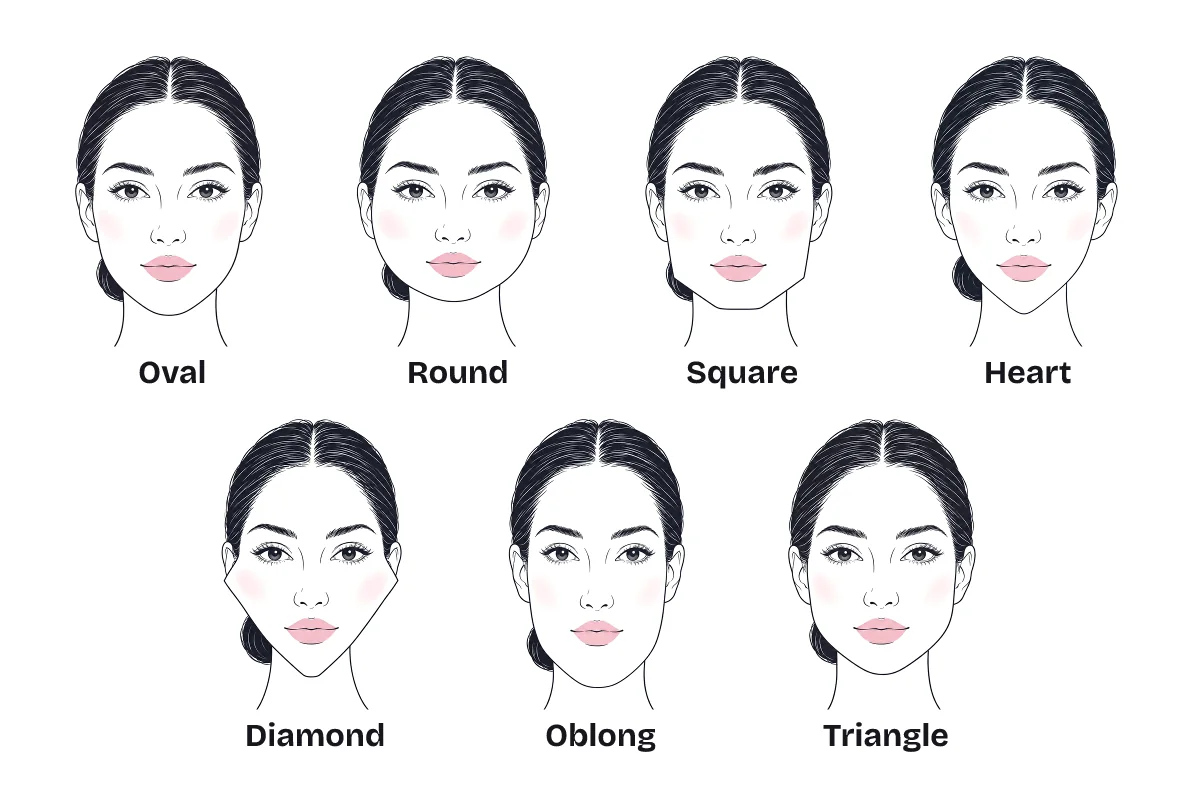
Your result is one of these seven, with the next closest shape alongside it. Each has a full styling guide:
- Oval: longer than wide, with a gently curved jaw.
- Round: similar length and width, soft at the jaw.
- Square: even widths and a jaw with clear corners.
- Heart: broad forehead tapering to a slim chin.
- Diamond: cheekbones clearly wider than forehead and jaw.
- Oblong: long, with sides that run fairly straight.
- Triangle: jaw wider than the forehead.
For how the seven compare side by side, which ones get confused and what suits each, see the complete guide to face shapes.
How to measure your face shape by hand
If you’d like a face shape calculator without a camera, all you need is a soft tape measure (or a piece of string and a ruler) and a mirror. Pull your hair back first.
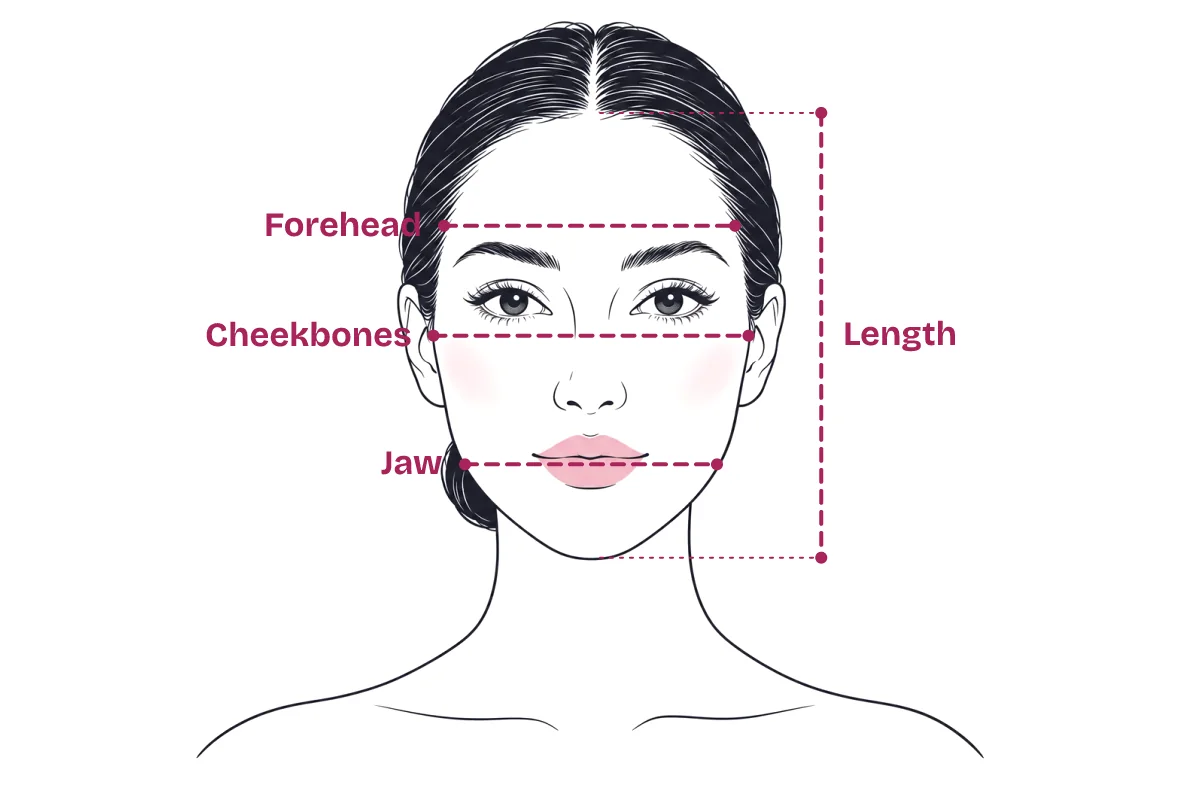
- Forehead: measure across the widest part of your forehead, about halfway between your eyebrows and your hairline.
- Cheekbones: find the most outer point of each cheekbone, just below the outer corner of each eye, and measure straight across.
- Jaw: measure straight across from one jaw corner to the other, just below the earlobes.
- Face length: measure from the middle of your hairline straight down to the bottom of your chin.
Then choose No photo in the tool above and enter the four numbers. The tool also asks whether your jaw corners are angular, soft or very rounded, and whether your chin is pointed, rounded or broad, because those details separate shapes that share similar widths.
To read your numbers yourself, start with length: if it’s about 1.3 times your cheekbone width or less, you’re likely round or square. If it’s 1.6 times or more, you’re likely oblong. Then compare the widths: widest at the forehead points to heart, widest at the cheekbones with a narrower forehead and jaw points to diamond or oval, and widest at the jaw points to triangle.
The mirror tracing method
Mirror tracing is a quicker, rougher face shape test. Stand arm’s length from a mirror with your hair pulled back, keep one eye closed so you don’t see double, and trace the outline of your face on the glass with a washable marker or an old lipstick. Step back and compare the outline with the chart above. It works best for clear-cut shapes. If your tracing looks like two shapes at once, that’s normal: use the tape method or the photo tool to break the tie.
How accurate is a face shape detector?
Face shapes are a styling convention, not a medical or scientific category, so there’s no single “true” answer to compare against. What a detector can do is measure consistently and be honest about its limits. These are the things that affect accuracy most:
- Close-up selfies. A phone held close to your face exaggerates whatever is nearest the lens. One study found a selfie taken about 30 cm (12 inches) away makes the nose base look about 30% wider than a photo taken from 1.5 m (5 feet). The same effect widens the middle of the face. Hold the phone at arm’s length or further, at eye level.
- Head angle. Turning or tipping your head changes width and length ratios. The detector checks your head position and asks you to adjust before it measures.
- Hair. Hair over the forehead, cheeks or jaw hides the outline. Pull it back.
- The hairline. As explained above, it’s estimated until you move the marker.
- Expression. A big smile widens the cheeks and changes the jaw. Use a relaxed, neutral face.
Each result shows a confidence level and the next closest shape. Low confidence usually means your face genuinely sits between two shapes, and styling advice for both will suit you.
Hairstyles, glasses and brows for your face shape
The detector gives you starting points for your result. Here’s the short version for every shape. Each face shape guide goes into much more detail.
| Shape | Hair ideas | Glasses ideas | Brows |
|---|---|---|---|
| Oval | Most cuts work; choose by hair texture | Frames about as wide as your face | Soft arch |
| Round | Height at the crown, long side-swept layers | Rectangular or square frames | Higher arch |
| Square | Soft layers, waves, side parts | Round or oval frames | Curved arch |
| Heart | Chin-length bobs, volume at the jaw | Bottom-heavy or rimless frames | Rounded arch |
| Diamond | Fringes, fullness at the jaw | Oval or cat-eye frames | Gentle curve |
| Oblong | Bangs, side volume, mid lengths | Deep frames with some height | Straighter brows |
| Triangle | Volume at the crown and temples | Browline or cat-eye frames | Fuller, longer brows |
None of these are rules. They’re ways to add emphasis where you’d like it, and you’re free to do the opposite on purpose.
Face shapes for men
The same seven shapes apply to everyone. What changes is the styling toolkit: beard shape and length can visibly change the outline of the jaw and chin, and short haircuts put more weight on the proportions of the top of the head. Switch the result to Men in the tool above for haircut, beard and glasses ideas, or read the face shapes for men guide.
Your privacy
Your photo is processed by software running in your browser and is never sent to us or anyone else. We don’t store it, and results aren’t sent anywhere either. The result card you can download shows your shape and tips, not your photo. Read more in our privacy policy.
Frequently asked questions
How accurate is a face shape detector?
A face shape detector gives a good estimate, not a verdict. The biggest sources of error are close-up selfies (they widen the middle of the face), a head that's turned or tipped, hair covering the forehead or jaw, and the hairline, which face-mapping software can't see. This detector checks your photo for those problems, lets you drag the hairline to the right place, and tells you how confident it is.
Is there a free face shape detector?
Yes. This one is free with no sign-up, no email and no paid report. It also runs on your own device, so your photo is never uploaded to a server.
Can ChatGPT tell me my face shape?
A chatbot can describe what it sees in a photo you upload, but it doesn't measure your face, and your photo goes to its servers. A dedicated detector measures specific proportions, explains the result and, in this case, keeps the photo on your phone. For a no-upload check, you can also use a tape measure.
Can I find my face shape without a photo?
Yes. Choose No photo above and enter four tape-measure values (forehead, cheekbones, jaw and face length), or answer five picture-based questions. The tape method uses the same rules as the photo method.
Is there a face shape app I can use on my phone?
You don't need to install one. This detector runs in your phone's browser on iPhone and Android, with your camera or a saved photo, and nothing is uploaded. You can add the page to your home screen if you want it one tap away.
Sources
- Face landmark detection guide (MediaPipe Face Landmarker), Google AI Edge
- Nasal Distortion in Short-Distance Photographs: The Selfie Effect (JAMA Facial Plastic Surgery, 2018), PubMed, US National Library of Medicine